Short answer: When a commercial ice machine stops making ice, the cause is usually water, scale or airflow, not the compressor. Check the water supply and filter, look for scale on the evaporator, and clean the condenser. If the machine still won't freeze or harvest after that, shut it off and call a technician before you run it dry or ice it up.
If you run a restaurant, a bar, a convenience store or a school kitchen, your ice machine is working every hour you are open. I'm Jason Hodges, owner of Meridian HVAC & Refrigeration, and ice machines are one of the most common calls we take across the Treasure Valley. The checklist below is what I'd walk an owner or manager through before the technician arrives. It also shows where the Treasure Valley's water and summer heat cause most of the trouble.
Why Treasure Valley ice machines struggle
Two local conditions explain a lot of the calls.
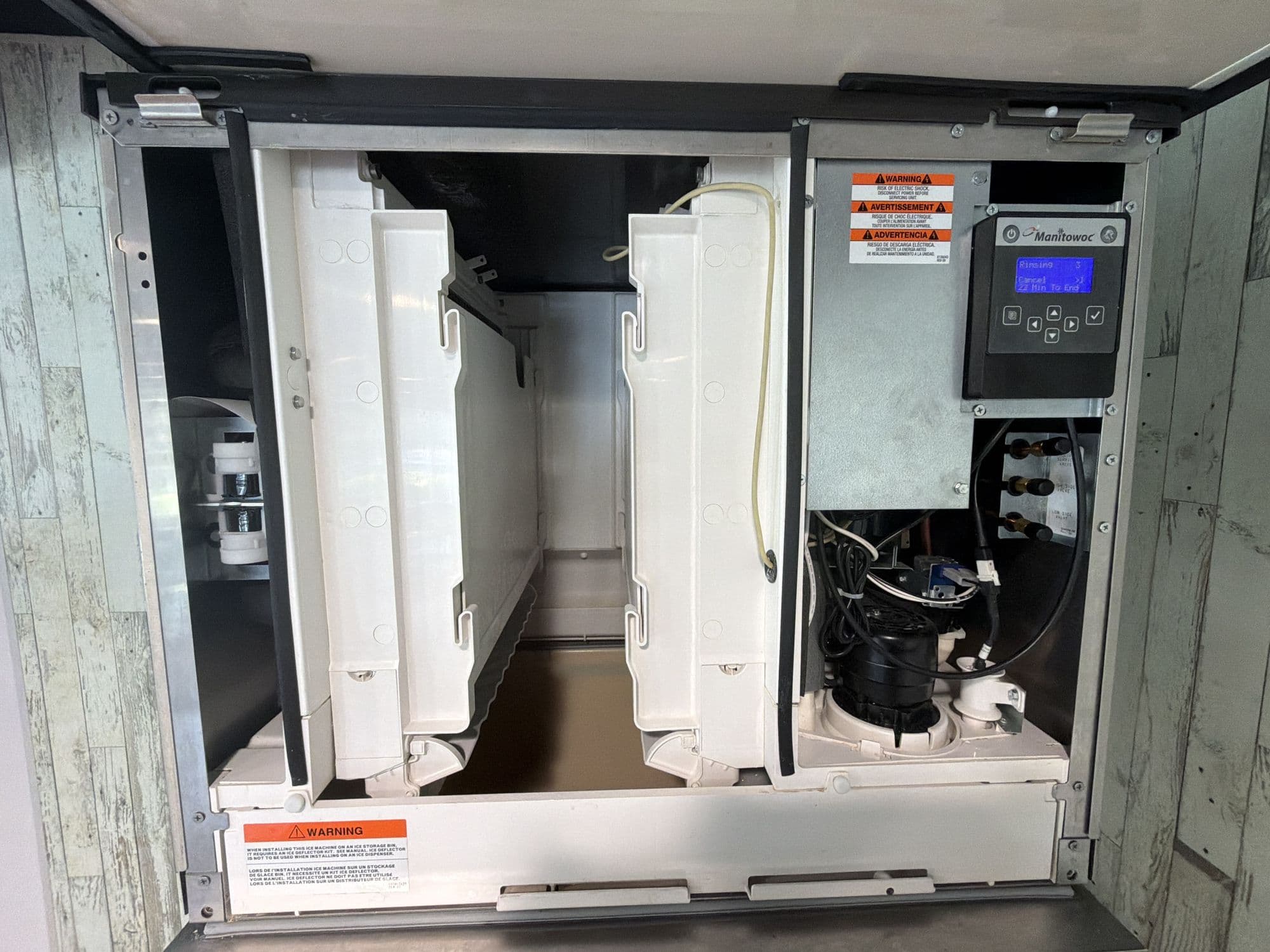
Hard water. Much of the water in the valley is hard, which means it carries dissolved calcium and magnesium. When an ice machine freezes water, those minerals stay behind as scale on the evaporator, in the water distribution tube, on the float or sensor and in the reservoir. Scale insulates the evaporator so it freezes less efficiently. It also clogs small water holes and makes sensors read wrong.
Summer heat. An ice machine rejects heat through its condenser. A condenser clogged with grease, dust or cottonwood fluff, in a hot back room or on a rooftop mechanical area, cannot dump that heat. Ice production drops, the machine runs long and eventually shuts down on a pressure or temperature safety.
What to check first (no tools needed)
Before you call, look at five things. None of them takes more than a couple of minutes.
- Is the machine actually on and in the freeze cycle? Check the power switch, the control panel for error lights, and whether the bin is full. A full bin or a bin-full sensor that has tripped will stop production on purpose.
- Is water getting in? Make sure the supply valve to the machine is open, the filter housing isn't blocked, and there are no leaks around the line. No water means no ice.
- Is the filter overdue? A clogged water filter cuts the flow to the machine. Filters follow the manufacturer's schedule, commonly every six months, and sooner on heavy-use machines or hard water.
- Is the air around the machine clear? Air-cooled machines need open space and a clean condenser. Check for boxes stacked against the machine and dust or fluff on the condenser fins.
- What does the ice look like? Cloudy, thin, hollow or slushy ice tells you something. See the table below.
Symptoms and likely causes
| Symptom | Likely cause | What to do |
|---|---|---|
| No ice, machine silent | Power, bin-full sensor, tripped control, failed component | Check power and bin; call if it won't start |
| Machine runs, no ice or very little | Water not reaching the evaporator: closed valve, plugged filter, failed water inlet valve | Check supply and filter; call if water is on |
| Ice is thin, hollow or cloudy | Scale on the evaporator, poor water flow, weak water quality | Descale and clean; replace the filter |
| Ice melts or machine "slushes" | Low refrigerant, dirty condenser, high room temperature, failing harvest parts | Clean condenser; call a technician |
| Ice freezes but won't release (stuck in freeze or harvest) | Harvest problem: failed harvest valve, sensor, thermistor or scaled evaporator; a repair, not a cleaning job | Shut off, don't let it ice up, and call |
| Machine cycles off on high pressure | Dirty condenser, failed fan motor, hot room | Clean the condenser; call if it continues |
| Water overflowing or leaking | Failed float, plugged drain, scaled reservoir | Shut off water and call |
| Ice tastes or smells off | Dirty bin, biofilm, old filter | Clean and sanitize the machine and bin; replace the filter |
The table is a starting point. Several causes show the same symptom, which is why a technician checks the water, the electrical side and the refrigeration side before changing parts.
Hard water and scale: the slow cause
Scale builds a little with every batch, so you may not notice it until production falls well below what it used to be. Warning signs are white or tan crust on the evaporator or water curtain, ice that comes out cloudy or in odd shapes, and slower cycles.
Descaling removes scale with an acid-based cleaner the manufacturer approves, followed by a thorough rinse. Use only cleaners made for your machine, and never mix chemicals. Cleaning and sanitizing an ice machine is a separate step from descaling and matters just as much, because ice is food. Our guide on commercial ice machine repair and sanitization covers the sanitizing side.
Filtration helps slow scale. A properly sized filter system, changed on schedule, protects the machine and improves the taste and clarity of the ice. For very hard water, a scale-inhibiting filter or a softener upstream may be worth asking about. If you use ice to hold cold items, remember that food safety is judged by temperature: the FDA Food Code (section 3-501.16) requires cold time/temperature-controlled food to be held at 41 °F (5 °C) or below, and a weak ice supply makes that harder on a hot service day.
Condenser and airflow
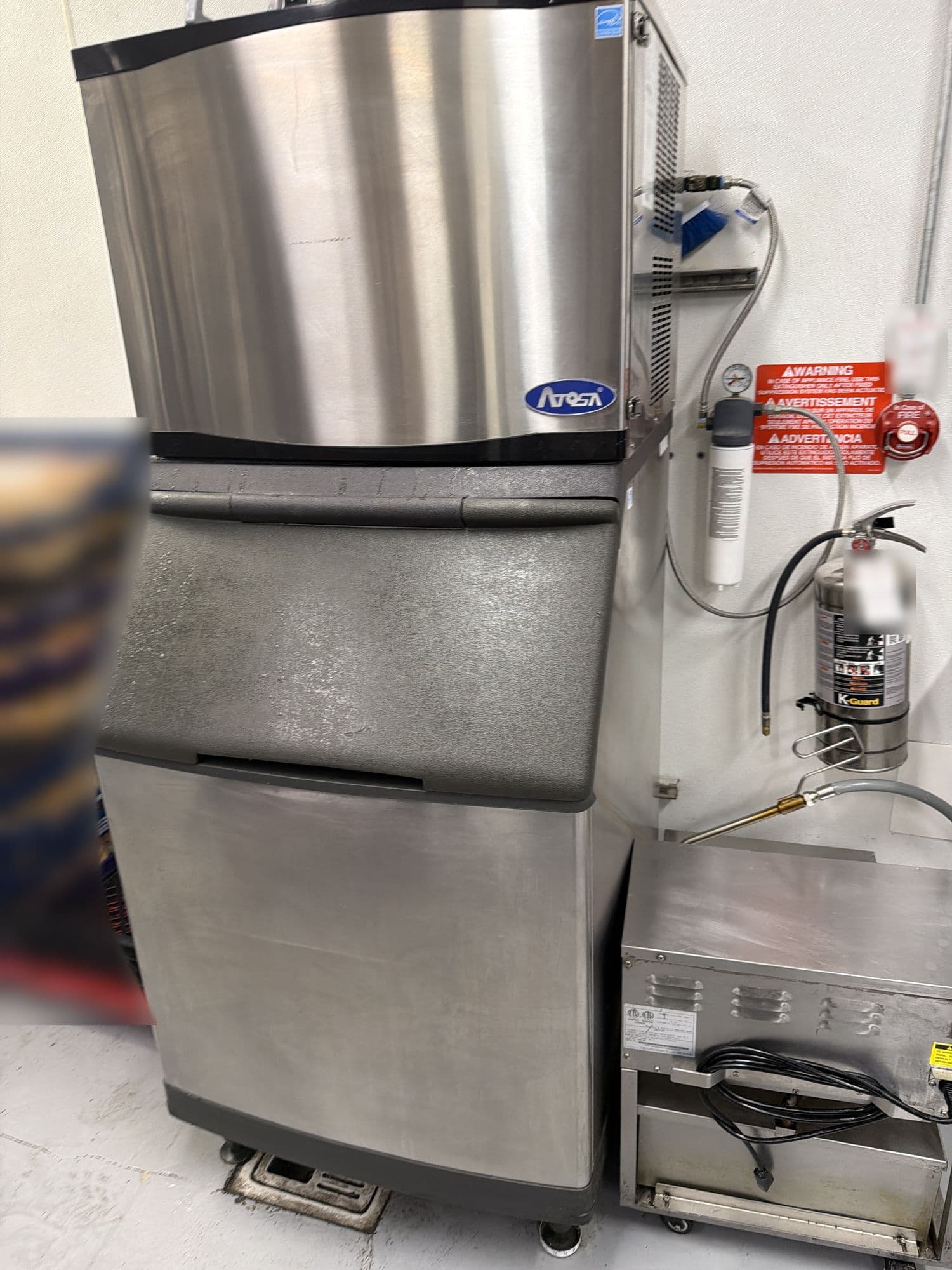
Air-cooled machines pull room air across a condenser coil. Grease in a kitchen, dust in a storeroom and cottonwood fluff in a rooftop or outdoor installation all block that air. Signs are long run times, warm air at the machine and the machine tripping off in the afternoon, when the building is hottest.
With the machine off and power disconnected, a soft brush and vacuum can clear surface dust. Do not use water on a condenser, and do not bend the fins. If the coil is greasy or the fins are packed, call us. Water-cooled machines have their own concerns, including scale in the water circuit and regulating-valve problems.
When to call a technician
Call right away if:
- You see water where it shouldn't be, or the machine is leaking.
- The machine trips breakers or makes grinding or loud noises.
- Filter replacement, a full bin check and a condenser cleaning haven't fixed the problem.
- Ice production keeps falling even after descaling.
- Ice is part of how you run your service, and you can't wait.
We work only on commercial equipment and service all brands. If the machine is a repeat problem, we'll tell you whether it is worth fixing or whether it's time to plan a replacement. Call (208) 477-1897; we answer 24/7. See our ice machine repair page for what we service.
A maintenance interval that works
Manufacturers commonly recommend cleaning and sanitizing at least twice a year, and more often in heavy-use or hard-water conditions. As a rule, in the Treasure Valley we suggest:
- Filter: replace on the manufacturer's schedule, sooner with hard water.
- Descale and sanitize: at least twice a year, with a technician check of the water system, sensors and condenser.
- Condenser: inspect and clean before summer and again if there is visible fluff or grease.
- Bin: wash and sanitize regularly, and never use the bin for anything but ice.
Follow your machine's manual first. If you'd rather not track it yourself, our maintenance plans are custom priced for your equipment and include priority dispatch.
Before the summer rush
Ice demand peaks when the machine is hottest, so descale, change the filter and clean the condenser before the first week of triple-digit heat. If you have walk-ins and prep tables, ask us to look at the whole refrigeration picture at the same visit, from restaurant refrigeration to ice. We serve Boise, Meridian, Nampa, Caldwell, Eagle, Kuna and the rest of the valley.