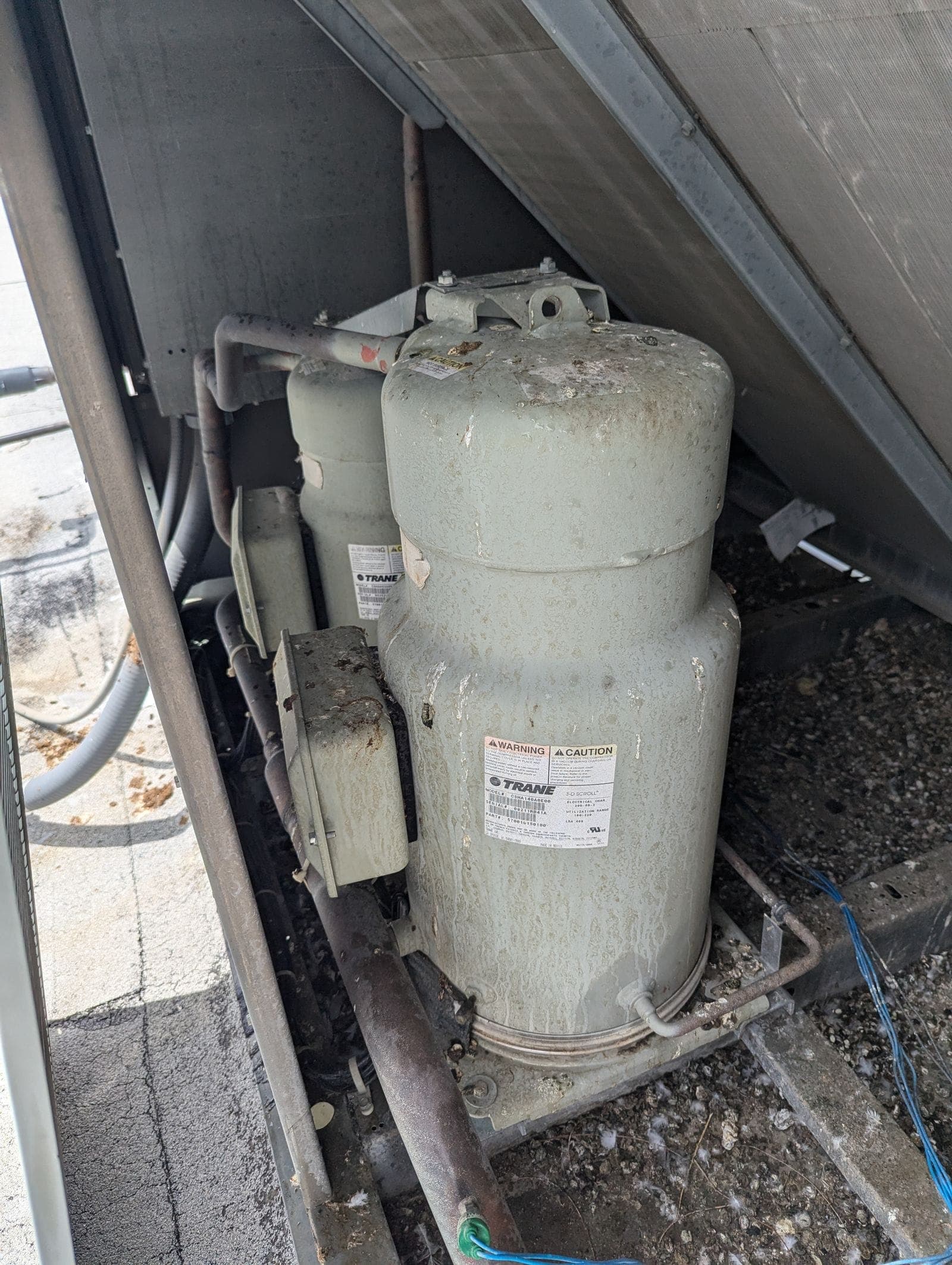
In a water source heat pump building, each office, suite, hotel room or apartment has its own heat pump, usually a horizontal unit above the ceiling, a vertical unit in a closet, or a console under a window. Every unit is tied into a shared water loop that runs through the building. In cooling, the units reject heat into the loop; in heating, they pull heat out of it.
A central plant keeps the loop in range: a boiler adds heat in winter, and a cooling tower or closed fluid cooler removes it in summer, with loop pumps moving water to every unit. That means a problem in one tenant's space can be the unit itself, the water reaching it, or the loop as a whole. Good service on these systems means checking all three, not just swapping parts on the unit that called in.
Most service calls start with a tenant who is too hot, too cold, or has water coming through the ceiling. These are the causes we find most often.
The unit runs, trips, and sits dead until someone resets it. We trace why: water flow, a fouled coaxial coil, loop temperature, airflow or refrigerant charge.
A unit stuck in heating or cooling, or one that switches but never quite gets there. We test the valve coil, the control signal and the valve itself.
Humming, clicking or a compressor that will not start. Contactors and capacitors are quick fixes; a failed compressor means a repair-or-replace decision.
No airflow, weak airflow or a noisy blower. We diagnose ECM motors and modules as well as older PSC motors, and check for the dirty filters that wear them out.
Scale and debris inside the water-to-refrigerant coil cut heat transfer and cause lockouts. We measure water-side temperature and pressure drop to confirm it.
Plugged strainers, stuck motorized valves, failed flow switches and kinked or collapsed hoses all starve a unit of water. We check flow at the unit and upstream.
When the boiler, cooling tower or fluid cooler is not holding the loop where it should be, units across the building lock out. We look at the whole loop.
Clogged pans, drains and traps in ceiling and closet units lead to water stains, wet ceiling tile and tenant calls. We clear them and check the overflow switch.
Wrong wiring, failed thermostats, bad control boards and fault codes that do not match the symptom. We read the board and verify each input and output.
With 40 or 200 heat pumps in a building, small neglected items add up: clogged filters wear out blower motors, slimed-up condensate pans overflow into ceilings, and dirty strainers starve units of water. A scheduled program catches these before they become tenant complaints.
We work through the building unit by unit and keep track of what we find, so you know which units are healthy and which are near the end of their life. Programs are priced as a custom contract for your equipment. See our commercial maintenance plans for how they work.
When a unit is past repair, we replace horizontal ceiling units, vertical closet units and console units, and can help you plan replacements across a building over several budget years. Learn more about our commercial installation work. Water source heat pump brands we commonly see and service include ClimateMaster, McQuay, Daikin Applied, Carrier and Trane, among others.
Lockouts, loop problems and maintenance explained
A lockout means the unit's safety control saw a high or low refrigerant pressure (or a freeze or condensate fault) and shut the compressor off to protect it. Resetting it may get the unit running for a while, but repeat lockouts almost always point to a real cause: low water flow through the unit, a fouled coaxial coil, loop water that is too hot or too cold, a dirty filter or failed blower, or a refrigerant problem. We find the cause instead of just resetting the board.
When multiple heat pumps fail around the same time, look at the loop before the individual units. A loop that is running too hot in summer (cooling tower or fluid cooler problem) or too cold in winter (boiler problem), a failed loop pump, or a clogged main strainer will cause lockouts across the building. We check loop temperature and flow along with the units.
The coaxial heat exchanger is the water-to-refrigerant coil inside each heat pump, a tube inside a tube with loop water on one side and refrigerant on the other. Over time, scale, sediment and debris from the loop build up inside, cutting heat transfer and causing pressure lockouts. Depending on condition, the coil can sometimes be cleaned; if it is badly fouled or leaking, it is replaced.
Yes. Horizontal units above ceilings in offices, hotel rooms and apartments are common. We coordinate access with property management, protect the space below, and plan the work around tenants and guests where we can.
It depends on the unit's age, the failed part, refrigerant type and the condition of the coaxial coil and cabinet. A blower motor or contactor is usually worth repairing; a failed compressor in an old unit with a fouled coil often is not. We give you the repair cost and the replacement option side by side so you can decide, including plans for replacing units over time across a building.
Yes. A program for a water source heat pump building typically covers filter changes, coil and condensate pan cleaning, drain line checks, electrical checks and refrigerant leak checks on every unit, plus a look at loop strainers and loop temperatures. It is priced as a custom contract for your equipment and your building.
We answer 24/7 and offer 2-hour emergency response. After-hours and emergency calls are billed at overtime rates. See our emergency commercial service, commercial HVAC and rooftop HVAC pages for more.
Response times can vary with location, weather and call volume.
See what our customers are saying this week
2 months ago
"Tech that came out was quick and very knowledgeable in fixing our commercial freezer. Had another company that came out before them that thought they fixed and did not. I will use this company moving forward and you should too. They came all the way to Ontario oregon, and was quick in response."
Tell us what's down and we'll call you back. For refrigeration or equipment emergencies, call — we answer 24/7.