
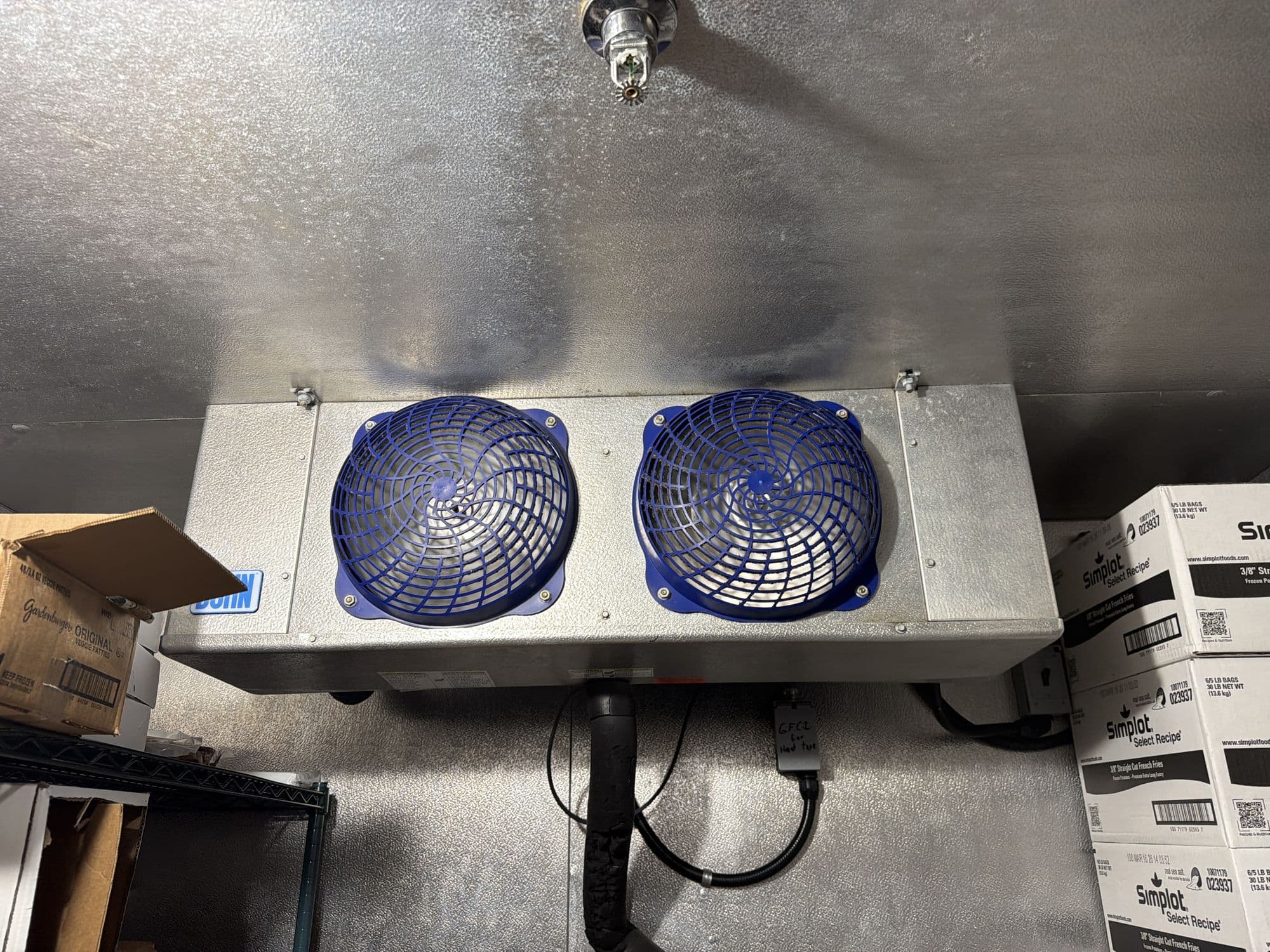
Short answer: Ice in a walk-in freezer is almost always one of three things: moisture getting in (doors, gaskets, a propped door), a defrost system that is not clearing the coil (heater, timer, termination sensor, drain), or airflow and refrigerant problems that make the coil run too cold. Staff can check the door and gaskets and clear stored product away from the evaporator. Defrost heaters, controls and refrigerant need a technician.
A little frost on a freezer coil is normal. Thick ice on the evaporator, a glacier on the floor or ice forming around the door frame is not. Ice cuts airflow, so the box warms up while the compressor runs harder. Left alone, it can stop a fan, send water where it doesn't belong and put product at risk. I'm Jason Hodges, owner of Meridian HVAC & Refrigeration. Here is how I would sort out where the ice is coming from, what you can safely check yourself, and when to call.
Where the ice is tells you where to look
| Where you see ice | Likely cause | First check |
|---|---|---|
| Heavy frost across the whole evaporator coil | Defrost not completing, or too much moisture entering | Is the coil clearing during a defrost cycle? Are doors being left open? |
| Ice only on the bottom of the coil or in the drain pan | Failed defrost heater or frozen drain line | Does the pan stay frozen after a defrost? |
| Ice on the floor under the evaporator | Drain line frozen or plugged; pan overflow | Look for ice around the drain line penetration |
| Ice around the door frame or gasket | Torn gasket, worn door sweep or a failed door heater | Close the door on a sheet of paper; if it slides out easily, the seal is weak |
| Ice on product or shelves near the door | Warm, humid air coming in during loading | How long is the door open, and is there a strip curtain? |
| Frost on the suction line back to the compressor | Low airflow or a refrigerant problem | Is the evaporator fan running? |
Cause 1: Moisture getting in
Every time the door opens, humid air comes in and freezes on the coldest surface, which is the evaporator. A walk-in that is opened constantly during a prep rush, a door that doesn't latch, a missing strip curtain or a torn gasket all load the coil with more moisture than it was sized to handle.
What staff can do:
- Check that the door closes and latches by itself and isn't propped open for deliveries or carts.
- Look at the gasket all the way around. Torn, flattened or hardened sections let air through. Ice that builds around one corner of the frame often marks the leak.
- Replace missing or ripped strip curtains if the walk-in has them.
- Keep warm product out. Hot pans and warm boxes put a lot of water vapor into the air.
- Check that the door closer and hinges aren't sagging. A door that hangs even a half inch low won't seal.
Cause 2: Defrost isn't working
A freezer evaporator is designed to collect frost, then melt it off on a schedule. The pieces involved are the defrost timer or controller, the defrost heaters, the termination sensor or thermostat that ends the cycle, and the drain line that carries the meltwater out of the box.
Common failures:
- Failed defrost heater. The heater elements are mounted in or around the coil. One burned-out element leaves part of the coil frosted while the rest clears.
- Bad termination sensor or control. If the cycle ends too early, ice remains. If it never ends, the box heats up.
- Timer or controller set wrong or failing. Too few defrosts per day lets frost accumulate. Settings should follow the equipment's manual, not a guess.
- Frozen drain line. The drain line from a freezer evaporator has its own heater. When that heater fails, meltwater refreezes in the line, backs up into the pan and builds ice in the box and under the coil.
None of these is a good do-it-yourself repair. Defrost heaters carry line voltage, sit inside a cold box, and have to be matched to the unit. If you see the symptoms above, call a technician.
Cause 3: Airflow problems
Cold air has to move across the coil. If the evaporator fan has failed, the coil can freeze solid, or the fan blades can ice up and stall.
What to look for, with power and safety in mind:
- Is the evaporator fan turning when the compressor runs? If you can see the coil, look for stopped fan blades.
- Is the coil or fan shroud blocked by boxes stacked too close? Leave clear space around the evaporator so air can circulate. Product shelved against the coil is a common cause.
- Is frost concentrated near the fan? That can mean a motor starting to fail.
If fans are not running, leave the diagnosis to a technician. A bad motor, capacitor or control relay can look the same from outside the box.
Cause 4: Refrigerant and system problems
A low refrigerant charge, a restriction or a defective expansion valve can make the evaporator run much colder than designed. The coil can freeze over in a pattern different from a plain defrost failure: ice that starts at the inlet side, frost on the suction line back to the compressor, or ice that returns very quickly after a defrost.
These need gauges and a licensed, EPA-certified technician. Don't top off refrigerant without finding the leak. A leaking system will only freeze up again.
What not to do
- Don't chip at the coil with a screwdriver or ice pick. Evaporator tubes and fins are thin, and a puncture means a refrigerant leak.
- Don't use a heat gun or open flame near the coil, and don't pour hot water over it. Use the defrost cycle, or have a technician advise on a controlled manual defrost.
- Don't tape or block the drain line to stop a drip.
- Don't keep resetting the breaker. If a heater or compressor trips, find out why first.
Protect the product first
Frozen food needs to stay frozen. The FDA Food Code requires that frozen food be maintained frozen, and a freezer that is icing up may be struggling to hold temperature. Check a thermometer inside the box, not only the display. If the box is warming, move product to another freezer or a backup and call for service the same day. If food has thawed and refrozen, ask your local health district what applies.
How to prevent ice buildup
- Keep doors closed and gaskets sound. Check gaskets monthly.
- Schedule coil and drain inspections. A maintenance visit that inspects the defrost system, fans and drain catches failures before ice appears.
- Check settings after anyone changes them. Defrost schedules should not drift.
- Keep product off the coil. Leave air space.
- Log temperatures daily. A slow trend upward often shows up days before the coil ices.
A planned maintenance visit costs far less in downtime than an emergency on a holiday weekend, and restaurants and grocers tend to learn that at the worst time.
When to call
Call a refrigeration technician if:
- The evaporator is more than lightly frosted after a defrost cycle.
- The fan isn't running.
- Ice is forming on the floor or around the drain line.
- The box can't hold temperature.
- You see frost on the compressor or suction line.
Meridian HVAC & Refrigeration repairs and maintains commercial walk-in coolers and freezers across the Treasure Valley. We answer 24/7, and for emergencies in the Treasure Valley we aim to have a technician on site within 2 hours (response times can vary with location, weather and call volume). Call or text (208) 477-1897 and we'll help you triage over the phone, or see our walk-in cooler and freezer repair page.