
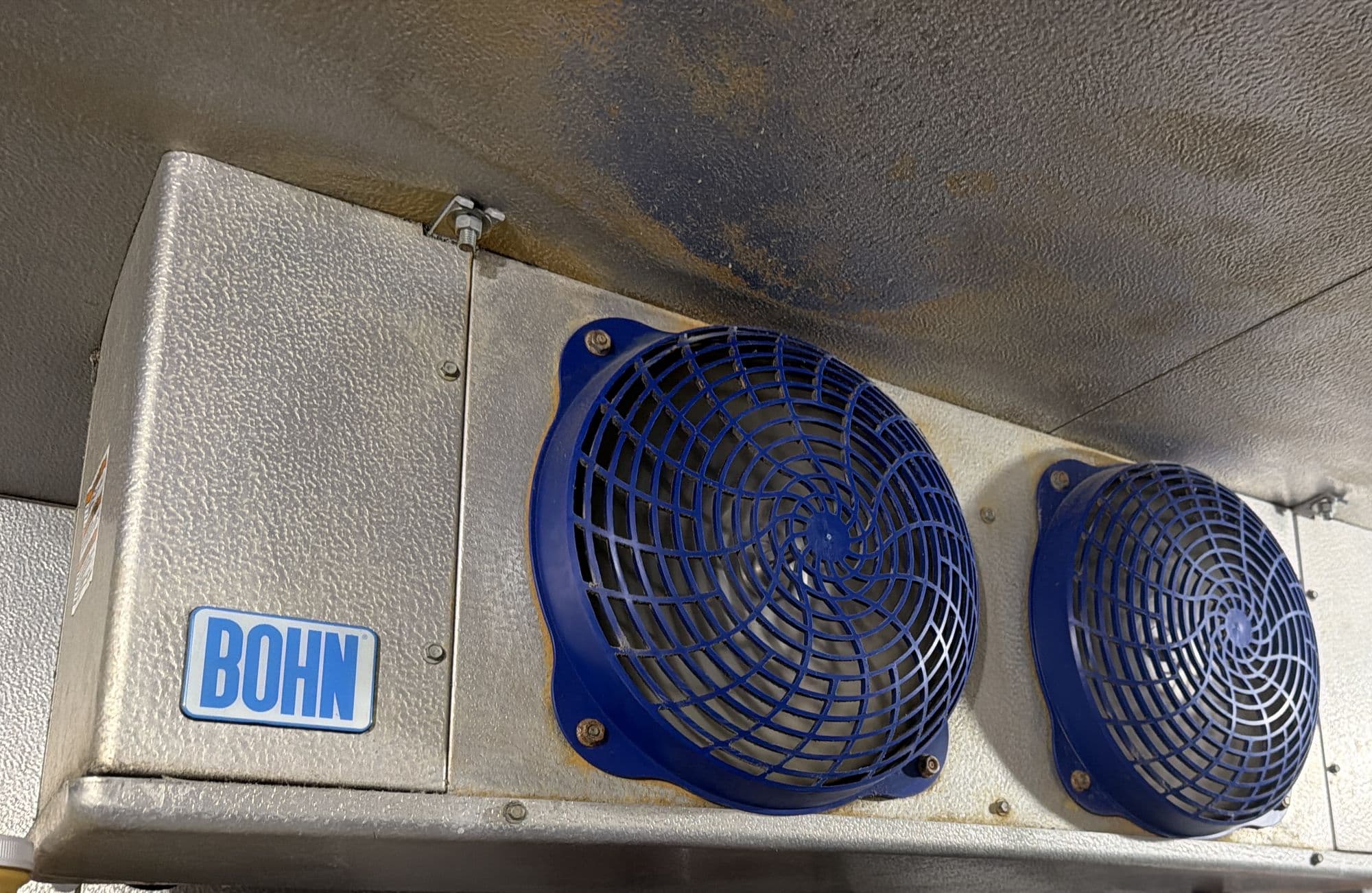
Short answer: If a walk-in or reach-in is warming up, call us first. Then, while you wait, keep the doors shut, check the real temperature by probing a product, and move the most at-risk food before it goes above 41 °F. Write down temperatures and times. You don't need to have answers ready when you call. Emergency calls typically get a technician on site within 2 hours.
When a walk-in or reach-in quits, the clock starts. I'm Jason Hodges, owner of Meridian HVAC & Refrigeration, and I've taken a lot of these calls. The ones that go best aren't always the easiest repairs. They're the ones where someone called right away and then did a few simple things to protect the product. Here's the plan I'd follow.
Step 1: call right away
Don't wait to see whether it fixes itself, and don't spend 40 minutes troubleshooting first. Call or text (208) 477-1897 as soon as you know the box is warming. If you have a few facts handy, great, but you don't need any of them to call. "My walk-in is warm" is enough. We'll ask what we need.
If you can easily see them, these help us bring the right parts:
- walk-in or reach-in, cooler or freezer
- the temperature now, and any code on the display
- whether anything changed recently, such as a power flicker, a delivery or a cleaning
Step 2: confirm the temperature
Don't rely only on the display. Use a food-safe probe thermometer in a product, away from the door. A display can be wrong. The product temperature tells you what the food is really doing.
Step 3: a few safe checks, nothing more
- The door. Is it fully closed and latched? A door propped by a cart or boxes, or a torn gasket, can make a unit look broken.
- The breaker. If a breaker is tripped, don't keep resetting it. A breaker trips for a reason, and it almost always trips again. Call us after the first trip.
- What you see and hear. Note whether the fan inside is turning, whether there's ice on the coil or water on the floor, and any alarm code. Tell the tech.
Leave the rest to a technician. Don't chip ice, spray the coil, open electrical panels, cut wiring or try to add refrigerant. We use water and tools on these units every day because we're trained for it. Untrained, those steps can hurt someone or damage the equipment, and we see that damage often. It ends up costing more than the original repair.
Step 4: keep the cold in
Keep the doors shut. A closed, insulated walk-in holds cold for a while, but every opening lets it out. Have one person decide who goes in and out.
Know your number. The FDA Food Code sets 41 °F (5 °C) as the most for cold holding of TCS food. TCS stands for "time/temperature control for safety": the foods that can grow bacteria quickly when warm, such as meat, dairy, cut produce and cooked dishes. If the box is climbing toward 41 °F, you're on a clock. Start moving product; don't wait to see.
Step 5: move product by priority
- Highest risk first: raw proteins, dairy, cut produce, cooked items and anything else TCS.
- Use what you have: another walk-in or reach-in with room, a neighbor or supplier with space, or coolers with ice or frozen packs. If you need more cold space, ask us. We can recommend cold storage box rentals in the area.
- Pack well: raw protein below ready-to-eat items, coolers closed, and don't overfill the working unit so air can still move.
- Freezers: a full freezer holds longer than a cooler. Keep the door shut and move only what you must. If frozen items start to thaw, ask your local health district what can be refrozen.
Don't use dry ice. It gives off carbon dioxide, and in a closed walk-in it can build up to deadly levels. People have died this way. It isn't worth the risk.
Step 6: write it down
This step gets skipped, and it matters for health inspectors, insurance and your own decisions about what to keep:
- when you found the problem, and the last time you know it was working
- temperatures with times, every 15 to 30 minutes
- what you moved, where and when
- photos of the display, any code, and any ice or water
If you're not sure food is safe, ask your health district before you serve it. When you can't show the temperature history, "if in doubt, throw it out" is the safe rule.
Most emergencies are preventable
Most of the refrigeration emergencies we see gave warning signs for weeks: a fan getting loud, a box that runs a little warm in the afternoon, ice building on a coil. A maintenance plan catches those before your busiest night of the year.
A Meridian HVAC & Refrigeration maintenance plan gives you:
- scheduled visits that catch worn parts before they fail
- priority dispatch when something does go down
- a service record for your equipment, useful for inspections and repair-or-replace decisions
See our maintenance plans or call to set one up. One avoided emergency (lost product, a closed kitchen, an after-hours call) usually covers a lot of maintenance.
After the emergency
- Ask what failed and why. If it was a worn part, find out whether others are due.
- Check the product before returning it, and let the unit pull back down to temperature first.
- Decide on the unit's future. One failure on a well-kept box is a repair. Repeat failures on an aging box are a different conversation; see walk-in cooler repair or replace.
- Make a plan for next time. Put our number on the walk-in door, list who to call, and know where backup storage is.
Call us
Call or text (208) 477-1897, 24/7. For non-emergencies, email contact@meridiancool.com. Emergency calls typically get a technician on site within 2 hours; response times can vary with location, weather and call volume. We handle commercial walk-in and reach-in refrigeration across Meridian, Boise, Nampa, Caldwell and the Treasure Valley. See walk-in cooler and freezer repair or our emergency commercial service page.
Sources: U.S. Food and Drug Administration, Food Code, section 3-501.16 (cold holding at 41 °F or less); confirm the edition your local health district has adopted.